Soy in the State
“Soy in the State: Connecting Sustainable Farms and Bio-based Fuels in New York” is an educational and outreach campaign led by Empire Clean Cities (ECC) in partnership with the New York Corn and Soybean Growers Association (NYCSGA).
The campaign highlights the important connection between upstate New York farmers — who grow soybeans and corn used in biofuel production — and downstate fleets and fuel users who benefit from cleaner, renewable fuels. Through community outreach, public events, and digital engagement, Soy in the State promotes the use of biodiesel and other soy-based fuels as a way to:
- Reduce greenhouse gas emissions and diesel pollution,
- Support local agriculture and clean energy economies, and
- Advance New York’s transition to more sustainable transportation.
Introducing Todd Dumond, Dumond Farms!
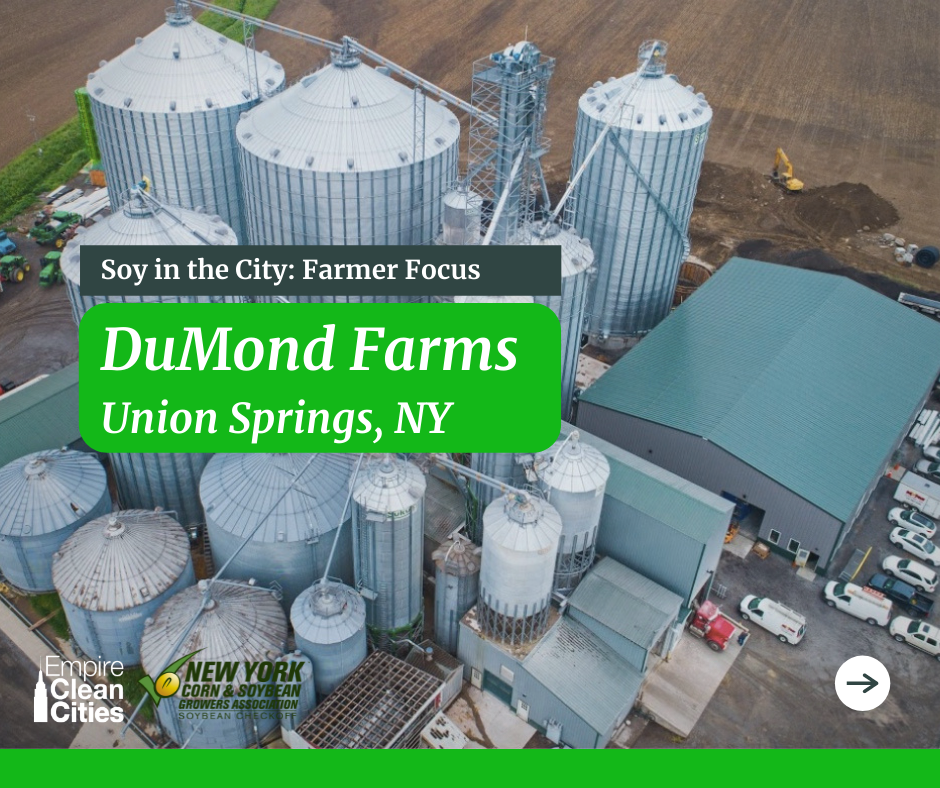
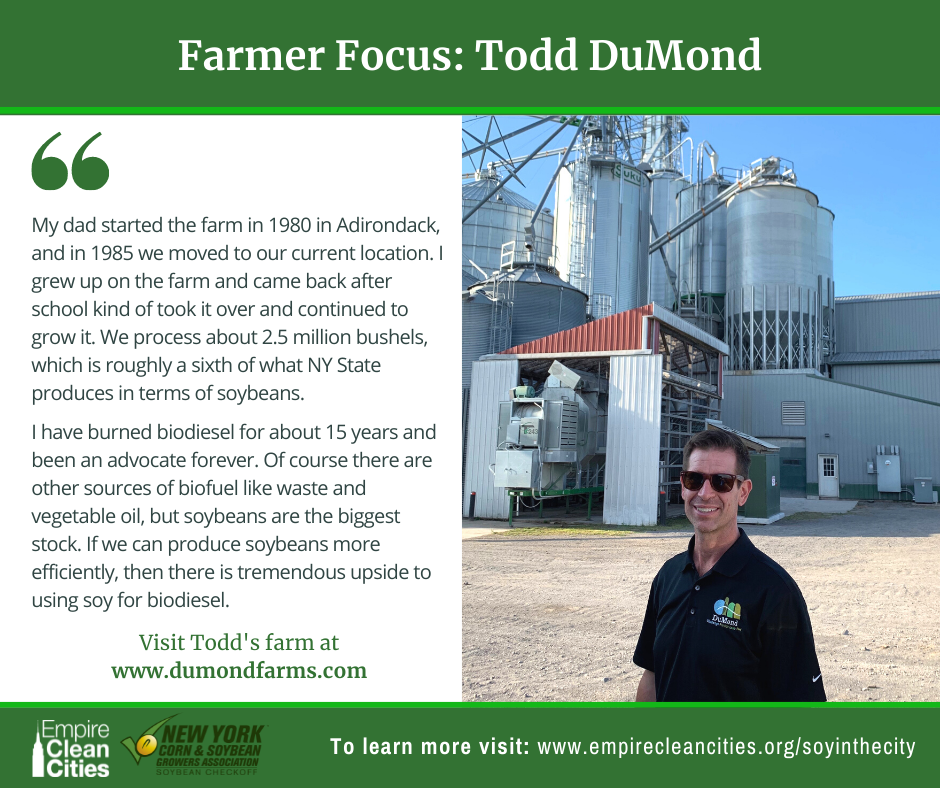
We are featuring Todd DuMond from DuMond Farms. Todd grew up on the family farm and continues to grow the operations and sustainability impacts to this day. Du Mond Farms processes about 2.5 million bushels, which is roughly a sixth of what NY State produces in terms of soybeans.
Learn more about Todd and his farm operations at www.dumondfarms.com!
Biodiesel Basics
What is Biodiesel?
Biodiesel is a clean, renewable fuel made from natural oils — such as soybean oil, used cooking oil, and animal fats. It can be used in most diesel engines without major modifications and is commonly blended with petroleum diesel (for example, B20 = 20% biodiesel + 80% diesel). Biodiesel meets both the biomass-based diesel and overall advanced biofuel requirement of the Renewable Fuel Standard. Renewable diesel is distinct from biodiesel.
The Benefits of Biodiesel
- Biodiesel is a domestically produced, renewable substitute for petroleum diesel. Using it as a vehicle fuel improves public health and the environment, contributes to a more clean transportation system, and supports home-grown agricultural feedstocks.
- Because biodiesel is made from renewable resources such as soybean oil, it helps reduce life-cycle carbon dioxide emissions by offsetting the carbon dioxide absorbed during the growth of the feedstock.
- Life cycle analysis completed by Argonne National Laboratory (PDF) found that B100 use reduces carbon dioxide emissions by 74% compared with petroleum diesel.
- Biodiesel improves fuel lubricity and raises the cetane number of diesel fuel, which helps protect engine components from wear and tear and promotes more efficient combustion.
- Compared with petroleum diesel, biodiesel is safer to handle and store because it is less combustible and has a higher flash point; it causes less environmental harm in the event of a spill and enhances overall fuel-supply resilience.
Vehicles that Can Use Biodiesel
Most diesel-powered vehicles can use biodiesel blends up to B20 (20%) with little or no modification. This includes:
- City and school buses
- Delivery trucks and vans
- Public works and utility fleets
- Construction equipment
- Personal diesel cars and pickup trucks
Biodiesel in the City
NYC operates the most sustainable fleet in the country. In 2007, the City began piloting the use of biodiesel blends to reduce emissions. Today, biodiesel blends are standard in all city fleet fueling sites.
Made from animal fat, soybeans, and other organic material, renewable diesel works in traditional diesel-powered vehicles. It can be used as a complete replacement for traditional diesel fuel as well as in blends with regular diesel fuel. During the recent demonstration period, this greener alternative fuel powered garbage trucks, Parks Department equipment, Department of Correction buses, NYPD emergency service units, and other heavy and specialized fleet units. NYC operates almost 13,000 diesel trucks and off-road equipment pieces that will benefit from this implementation. The emissions reductions achieved during this period is equal to removing trucks driving three million miles on New York City’s streets.
By July 2026, all city trucks and vessels will use renewable diesel and be powered by used cooking oil and waste tallow
NYC operates the most sustainable fleet in the country. In 2007, the City began piloting the use of biodiesel blends to reduce emissions. Today, biodiesel blends are standard in all city fleet fueling sites.
Made from animal fat, soybeans, and other organic material, renewable diesel works in traditional diesel-powered vehicles. It can be used as a complete replacement for traditional diesel fuel as well as in blends with regular diesel fuel. During the recent demonstration period, this greener alternative fuel powered garbage trucks, Parks Department equipment, Department of Correction buses, NYPD emergency service units, and other heavy and specialized fleet units. NYC operates almost 13,000 diesel trucks and off-road equipment pieces that will benefit from this implementation. The emissions reductions achieved during this period is equal to removing trucks driving three million miles on New York City’s streets.
By July 2026, all city trucks and vessels will use renewable diesel and be powered by used cooking oil and waste tallow
Biofuel Fueling Stations in New York
You can find public/private biodiesel stations across New York State using the U.S. DOE Alternative Fuels Data Center – Station Locator.
Loading alternative fueling station locator...
If you are a state or non-state agency looking to procure on-road fuel under a New York State contract…
The New York State Office of General Services (OGS) offers a statewide fuel contract that streamlines the purchasing process for eligible organizations. Through this contract, authorized users can easily purchase on-road fuels including:
- Ultra-Low Sulfur Diesel (ULSD) – Regular and Premium
- Biodiesel blends – B5, B10, and B20
- Hydrogenation Derived Renewable Diesel (HDRD95B5)
For current contract pricing, supplier information, and enrollment details, visit the official OGS Procurement page for more.
Source: New York State Office of General Services, Corning Tower, Empire State Plaza, Albany, NY 12242.
Soy in the State
Empire Clean Cities is proud to partner with New York Corn & Soybean Growers Association (NYCGSA) on the "Soy in the State: Connecting Sustainable Farms and Bio-based Fuels in New York" project.